What Are Geometry Drawing Languages?
Geometry sketch languages are systems that use text commands to generate figures, constructions, and transformations. Users describe objects using textual instructions rather than drawing them directly using a pencil, pen, or any other device. As a result, the diagram created from code is yet another way to look at objects, each point, line, and curve obediently following the principle.
These languages bind mathematics with programming. These languages are developed either in general scripting environments or in a program-specific context dedicated to mathematical requirements. Yet, the concern remains constant in both cases: Geometry is a subject that is described formally and not merely a matter of visual observation.
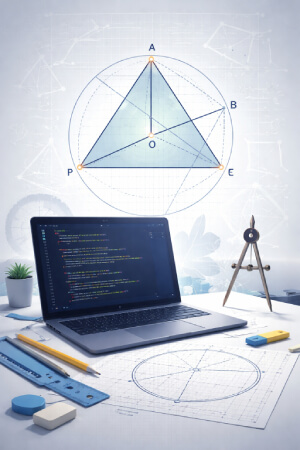
From Compass and Straightedge to Script
Classical geometry relied on physical tools such as the compass and straightedge. These tools enforced constraints. You could draw a circle with a given center and radius or construct a perpendicular bisector, but you had to follow specific steps. Geometry drawing languages preserve this spirit. Instead of manipulating metal instruments, you write instructions that mirror those constructions.
For example, rather than dragging a circle onto a canvas, you might define a center point and specify a radius mathematically. This approach reinforces understanding because it requires you to think in terms of relationships. A circle is not just a round shape. It is the set of all points at a fixed distance from a center. Writing that definition in code makes the concept explicit and precise.
Text as a Medium for Visual Thinking
Using text to produce visual output may seem indirect at first. However, it offers a unique advantage. Text encourages structure. When you describe a triangle by defining three points with coordinates, you are forced to consider how those points relate to each other.
Text-based systems also make it easy to modify diagrams. If you want to change the length of a side or the position of a vertex, you adjust a value and regenerate the image. This flexibility supports experimentation. Students can explore what happens when parameters shift, observing patterns that might be difficult to see in static drawings.
Common Platforms and Tools
Several widely used tools support geometry through code. For example, GeoGebra allows users to combine algebra, geometry, and scripting to create dynamic constructions. In academic publishing, TikZ is popular for producing precise diagrams within LaTeX documents. Another well-known system is Asymptote, designed specifically for technical mathematical graphics.
Each of these platforms provides a slightly different balance between visual interaction and textual control. Some emphasize interactive exploration, while others focus on publication-quality precision. Together, they illustrate how geometry drawing languages serve multiple audiences, from classrooms to research journals.
Why Code Enhances Geometric Understanding
Coding geometry encourages system thinking besides promoting clean diagrams. This active realization reshapes thought, concretizing ideas, and bringing the logic behind the geometric relationships to the fore.
The robot kits encouraged important thoughts regarding programming and geometry alike evidence for the case of bringing alternate educations together. Thinking organizationally, in stark contrast to relying only on intuition, forces a student to account for every step in a very verbal order. This relationship improves both mathematical reasoning and functional numerals, i.e., computational literacy.
Making Definitions Explicit
In many traditional classrooms, definitions are memorized and then applied to problem sets. When working with geometry drawing languages, definitions become operational. To create a perpendicular line, you must express what “perpendicular” means in terms of slopes, vectors, or transformations.
This requirement eliminates ambiguity. A line perpendicular to another is not simply one that “looks” at a right angle. It must satisfy a precise condition. When learners implement that condition in code, they see directly how algebraic relationships produce geometric results. The connection between equations and shapes becomes tangible.
Encouraging Exploration Through Parameters
One powerful feature of text-based geometric scripting is the use of parameters. Instead of defining a fixed triangle, you can define a triangle whose vertices depend on variables. By adjusting those variables, you observe how the figure changes.
For instance, you might define a triangle with one side fixed and another angle controlled by a parameter. As the angle varies, the triangle reshapes itself automatically. This dynamic approach highlights invariants and patterns. Students can investigate which properties remain constant and which depend on specific conditions.
Such exploration supports conceptual insight. Rather than solving isolated examples, learners engage with families of figures, seeing general principles in action.
Reducing Cognitive Overload in Complex Diagrams
In advanced geometry or research settings, diagrams can become intricate. Multiple constructions intersect, and small inaccuracies can lead to confusion. Code-based systems reduce these risks. Once relationships are defined, the software maintains them consistently.
If a point is defined as the midpoint of a segment, it will remain the midpoint even if the segment changes length. This reliability allows researchers to focus on ideas rather than manual adjustments. It also benefits students, who can trust that the diagram reflects the intended relationships accurately.
Applications in Education
The use of geometry drawing languages in the classroom is increasingly common at all levels-students therein are introduced into a structured framework that lets them explore mathematical ideas.
A computer-based activity in the geometry classroom has been opened up for interdisciplinary skills to be rendered. Instead of concentrating on the conventional content of geometry, students probe logical reasoning, algorithmic thinking, and the techniques of clear communication.

Supporting Conceptual Learning in Schools
In school settings, geometry is often introduced visually. Students draw shapes and measure angles, sometimes without fully understanding the underlying rules. Text-based geometry can address this gap by requiring explicit construction steps.
For example, instead of drawing an equilateral triangle by approximation, students can define three points such that all pairwise distances are equal. The code ensures exact equality, reinforcing the formal definition. Over time, this precision builds a stronger conceptual foundation.
Moreover, scripting encourages revision. If an initial construction is incorrect, students must identify the logical error and adjust the instructions. This process mirrors mathematical proof, where each step must be justified.
Integrating Geometry with Programming Curricula
As coding becomes part of many educational programs, geometry offers a natural context for practice. Writing scripts to generate polygons, tessellations, or transformations makes programming meaningful and visually rewarding.
Students can see immediate results. A few lines of code can produce a symmetrical pattern or a rotating figure. This feedback motivates experimentation. It also demonstrates how mathematical structures underpin many digital graphics systems used in games, design, and scientific visualization.
By linking geometry and programming, educators show that mathematics is not isolated from technology. Instead, it forms a foundation for many modern tools.
Assessment and Reproducibility
Another educational advantage of geometry drawing languages is reproducibility. When students submit code rather than static images, instructors can run the script and verify that constructions follow the required logic.
This transparency supports fair assessment. Teachers can evaluate both the final diagram and the reasoning encoded in the instructions. It also encourages good documentation practices, as students must write clear and organized scripts.
In higher education, reproducibility is essential. Research assignments that include geometric modeling benefit from scripts that others can review and modify.
Research and Advanced Mathematical Visualization
Beyond classrooms, geometry drawing languages play a role in mathematical research. Complex proofs often rely on carefully constructed diagrams. Inaccurate visuals can obscure subtle relationships or mislead readers.
Text-based systems provide a way to produce consistent, high-quality graphics that align precisely with theoretical arguments.

Precision in Academic Publishing
In research articles, diagrams must reflect exact relationships. If a paper discusses tangency, concurrency, or symmetry, the visual representation should embody those properties accurately. Tools such as Asymptote and TikZ are widely used in mathematical journals for this reason.
Authors can define coordinates symbolically or numerically, ensuring that intersections and angles are correct. Because diagrams are generated from code, they can be updated easily if parameters change during the revision process. This flexibility supports clarity and rigor.
Modeling Transformations and Higher Dimensions
Geometry drawing languages are not limited to simple plane figures. Many systems support transformations such as rotations, reflections, and scaling. These operations can be applied systematically to generate patterns or explore symmetry groups.
In more advanced contexts, scripting can represent three-dimensional objects and projections. Researchers studying topology or differential geometry may use coded visualizations to illustrate surfaces and curves. While the underlying mathematics can be abstract, programmable diagrams help communicate structure effectively.
By encoding transformations explicitly, researchers make their reasoning transparent. Each visual step corresponds to a defined mathematical operation.
Collaboration and Sharing
Because scripts are text-based, they can be shared easily through academic platforms and repositories. Colleagues can review the code, suggest improvements, or adapt it for related problems. This openness aligns with broader trends in reproducible research.
When geometry is expressed in code, it becomes part of a larger computational ecosystem. Scripts can be version-controlled, documented, and integrated with other analytical tools. This integration strengthens collaboration across institutions and disciplines.
Balancing Visual Intuition and Formal Structure
Geometry drawing languages do not replace traditional visual intuition. Instead, they complement it. A hand-drawn sketch can capture an idea quickly, while code refines and formalizes it.
The balance between intuition and structure is central to effective learning and research. Too much emphasis on appearance can obscure logical relationships. Too much abstraction can feel disconnected from spatial understanding.
When to Sketch and When to Script
Early exploration often begins with a rough drawing. A quick sketch helps clarify the overall configuration of a problem. Once the relationships are understood conceptually, scripting can translate that idea into a precise construction.
For students, this progression reinforces learning. They begin by visualizing and then move toward formalization. For researchers, it ensures that published diagrams align exactly with theoretical claims.
Knowing when to move from sketch to script is a practical skill. It reflects an awareness of the goals of the task, whether exploratory or communicative.
Developing Computational Literacy in Mathematics
As mathematics increasingly intersects with computation, familiarity with text-based tools becomes valuable. Geometry drawing languages introduce core ideas such as variables, functions, and modular design in a concrete context.
Learners who script geometric constructions gain experience breaking problems into smaller steps. They learn to define reusable components, such as functions for drawing regular polygons or calculating intersections. These habits mirror broader programming practices and prepare students for more advanced computational work.
Importantly, this literacy does not diminish geometric insight. On the contrary, it can deepen it by revealing the algorithmic structure behind familiar shapes.
Accessibility and the Learning Curve
Adopting geometry drawing languages requires time and guidance. Beginners may find syntax challenging at first. However, many platforms provide interactive feedback and extensive documentation.
Once basic commands are understood, the process becomes intuitive. Writing a line or defining a point follows clear patterns. With practice, the focus shifts from syntax to structure. Educators can support this transition by introducing scripting gradually, pairing visual exploration with textual construction.
Over time, students often report that coding geometry feels natural. The discipline of writing precise instructions becomes part of their mathematical thinking.
Technical Foundations Behind Geometry Scripting
Geometry drawing languages rely on mathematical models that translate abstract relationships into coordinate-based representations. At their core, most systems use analytic geometry, where points are defined by coordinates and shapes are expressed through equations or vector relationships. This structure allows the software to compute intersections, distances, angles, and transformations with exact numerical consistency.
Underneath the visible diagram is a layer of computation. When you define a circle by its center and radius, the system calculates all points satisfying that condition. When two objects intersect, algorithms determine their meeting points using algebraic methods. Because these calculations are handled programmatically, diagrams remain internally consistent even as parameters change.
This technical foundation ensures reliability. It also highlights the deep connection between algebra and geometry. Code acts as the bridge, translating symbolic expressions into visual form while preserving mathematical integrity.
Future Directions in Computational Geometry Education
As digital learning environments expand, geometry scripting is likely to become more integrated into mainstream mathematics education. Interactive notebooks, browser-based coding platforms, and hybrid visual-text tools are making these systems more accessible to beginners without sacrificing precision.
One emerging direction is the combination of automated reasoning with diagram generation. In such environments, students might construct a figure and then verify geometric properties through embedded proof assistants. This integration can support deeper understanding by linking construction, visualization, and logical validation in a single workflow.
Another promising development involves collaborative, cloud-based projects. Students and researchers can co-create geometric models in shared spaces, refining constructions together in real time. As computational literacy becomes a standard skill, geometry drawing languages may serve not only as teaching tools but also as gateways to broader scientific and technical fields.
Geometry as a Living Language
Geometry, from ancient drawing to digital representation, has undergone a tremendous revolution. The text-based drawing languages present a culmination of this tendency. By marrying mathematical rigour with the control of a computer programme, they allow diagrams to morph from static to dynamic depictions of structure.
Scripting geometry promotes clarity, encourages experimental research, and emphasises unchanging analytic principles. It uncovers the logic behind shapes; thereby relating visual intuition to formal reasoning. Thus, giving the impression that geometry is not only that we see, but that we can also articulate, refine, and pass through the medium of code.
Computational geometry is a field of computer science that deals with the study of algorithms and data structures related to complex 3D ultrametric spaces. It involves the use of math and Algebra to solve problems such as: geometric transformations, intersection and proximity… pic.twitter.com/yMKLi7VFtP
— Maurizio Iβλἄ (@Dragonmaurizio) August 3, 2024
Topology of a catenoide
— Daniel Mentrard (@dment37) February 22, 2026
Visualization |Animation | Interactive applet@geogebrahttps://t.co/s8R8SUoBzg
#geogebra #math #science #iteachmath #mtbos #visualization #elearning @bancoche #physics pic.twitter.com/uzgUQpCggn